
Supplying Crimea, Part 2
by Donald Hill

(…continued from Part 1…)
The Crimean peninsula lies between the Black Sea and the Sea of Azov. At the narrowest point, 90 km of the peninsula is separated from mainland Europe by the Syvash lake and lagoons. Only nine kilometers of solid land connects the peninsula and the continent, and Armiansk was built at that location. A hundred years ago, there wouldn’t be any bridges to bomb here, but construction on the Kakhovka dam was completed in 1956, and in that year work began on the North Crimean Canal to carry water from the Kakhovka reservoir to the Crimean peninsula.
All the bridges entering Crimea from the east cross the Syvash Lake and lagoons. All the bridges in the west cross the canal.
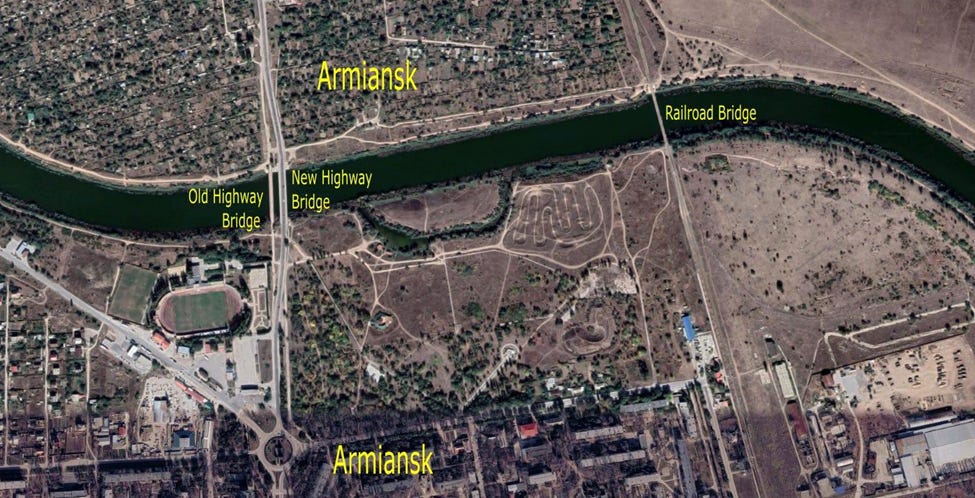
Because of the canal, there are a couple dozen bridges that connect northern Crimea to southern Crimea. 15 more bridges cross the canal in Kherson, as well. With the Armiansk bridges knocked out and the pontoon bridges being attacked before or soon after they are erected, Russian trucks have to cross the canal further west in Kherson before they can head south into Crimea.
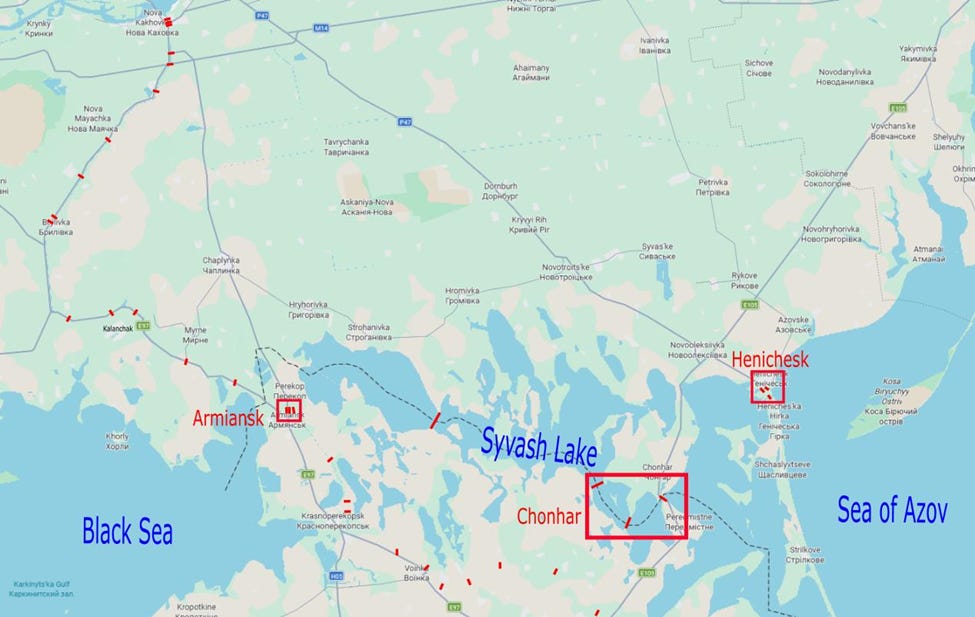
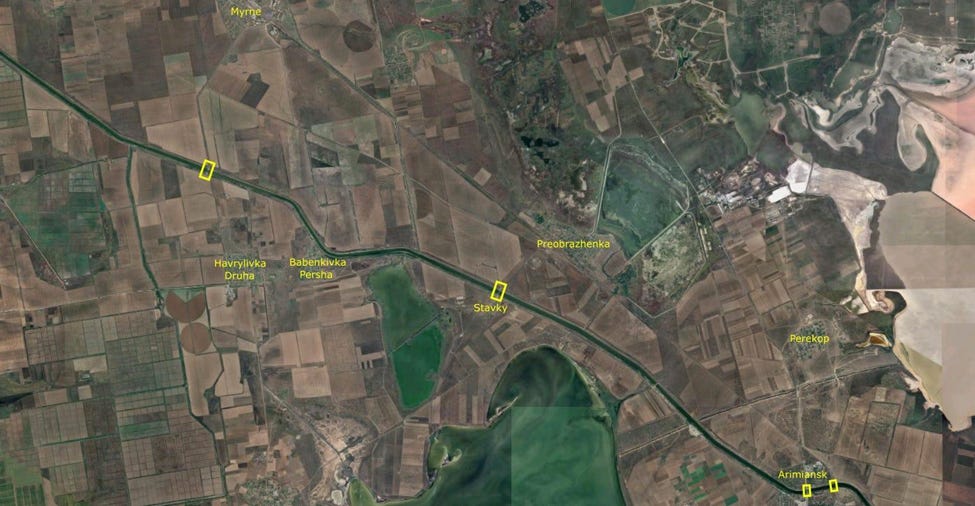
Currently, all the roads near the Azov Sea are blocked, and the highway near the Black Sea is blocked. Two of the bridges on secondary roads are blocked but 13 other bridges are unblocked. Crimea is not cut off from vehicular traffic but Russian trucks have to make a detour of several hours to enter Ukraine. This detour keeps the logistical traffic within range of Ukraine’s mid-strike drones for a longer period of time, and the closer the trucks are to the front lines, the easier it will be to detect and attack them.
The concrete bridges will be difficult to repair while Ukrainian drones can attack them. Pontoon bridges are easily damaged and easily repaired, so they will have to be constantly attacked. Each delay costs time. Trucks are vulnerable to attack while they are waiting until a pontoon bridge can be reestablished .
More of the canal bridges can be destroyed. Pontoon bridges can be set up at each of the crossings so these sites have to be constantly monitored and attacked when a new bridge is erected. Russia has a lot of pontoon bridges, but not an unlimited supply.
Any delays in logistical runs are good. The prevention of logistical deliveries is better. The destruction of the logistical cargo is best.
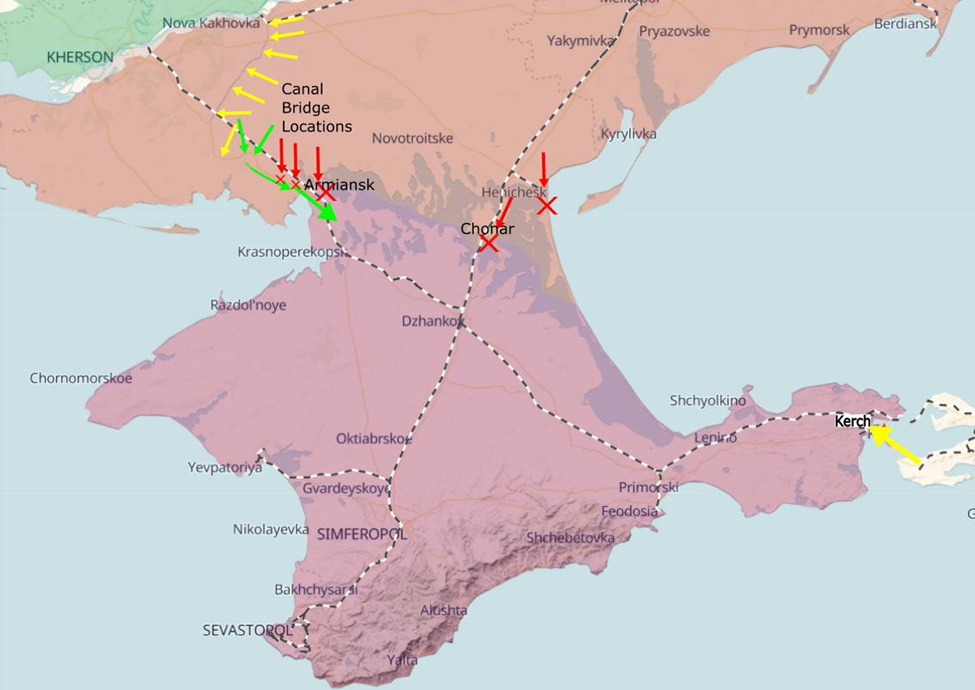
Currently, trains cannot enter Crimea from the north and trucks can only enter from the north if they use a canal bridge north of Armiansk. It is likely that Russia will spend more air defense resources to protect and open these crossings but this will also make those defenders targets, as well. Two BMPs were supposed to shoot down drones and, at a minimum, they each took at least one FP-2 out of the fight before they were destroyed. Infantry that was deployed to shoot down drones observe a strike a few hundred meters away. A Russian blogger says they are not able to stop the Ukrainian drone attacks and Crimea will be without electricity soon.
Russia’s other option is to start using the Kerch bridge once again to transport fuel, ammo and equipment. When this happens, it will indicate that Russia can no longer sustain their forces in Crimea through the occupied territories. The Kerch bridge is 250 km away from the front lines and it is likely that Ukraine already has plans to destroy it.
Thanks Tom and Don, the ZSU maintaining an UAS air superiority/DEAD campaign against the VSRF for 250 km from the FLOT looks good, hope it will overcome any Russian countermeasures.
Good analysis!