
Creating Obstacles and Using Time as a Weapon, Part 1
by Donald Hill

Ever since Russia’s defeat in the Ukraine’s Slobozhanska Offensive, back in September-October 2022, one of primary goals on the battlefield - for both Ukraine and Russia - is to prevent the enemy units from receiving replacement soldiers or supplies, such as ammo, fuel, water and food. Destroying supplies is preferred, since those supplies will never be a threat again. Blocking supplies is the next best thing because it prevents an enemy unit from receiving supplies, but the supplies still exist and can be sent by a different route or method, or used somewhere else. Yet even delaying the arrival of the supplies is useful because if a unit receives ammo quickly, it can expend ammo quickly. If a unit receives ammo slowly, then it has to slow down its rate of expenditure or it will run out of ammo.
Delaying drone supplies is immediately useful. Delaying fuel means vehicles and generators have to be used less often. Delaying food and water may not mean much for a day, but if the soldiers only receive half as much food and water as they need over a week their ability to function degrades.
Near the front lines, Ukraine is creating obstacles to delay, block and destroy Russian infantry and vehicles. These front line obstacles need to be built, but in the logistical war in Russia’s rear areas, Ukraine is taking advantage of the rivers and creating obstacles by damaging and destroying bridges.
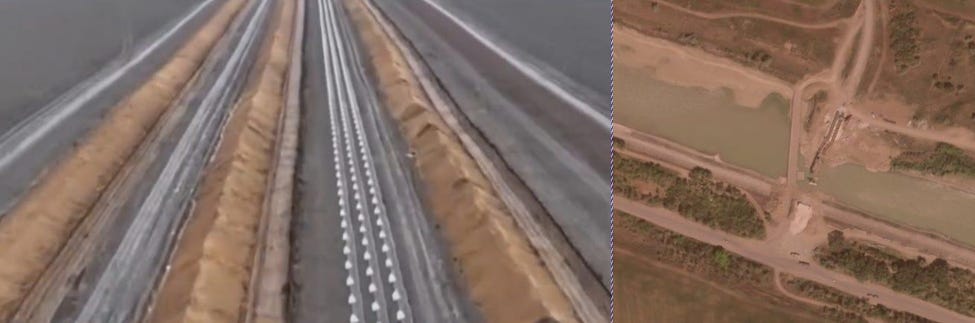
If a route is broadly defined as roads passing near or through Armiansk, Chonar, Henichesk and Kerch, then Ukraine has not blocked any routes yet. Blocking is a persistent state that requires lack of action on the part of Russia or constant reaction from Ukraine. If the vehicular and rail portions of the Kerch bridge were theoretically destroyed and Russia was unable to repair it, then that route would be blocked.
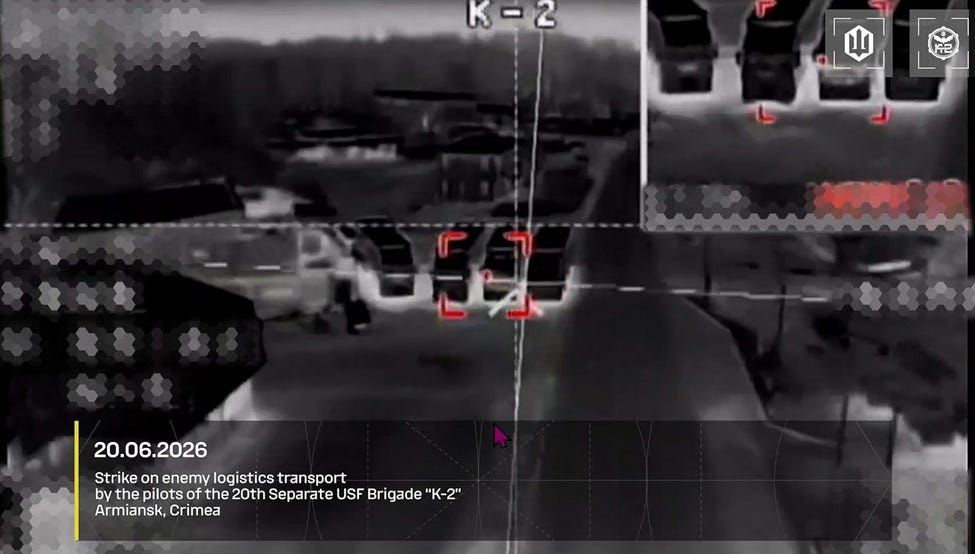
What Ukraine has done is create long delays. The delays slows the rate of Russian supply and it also keeps the Russian trucks in the ‘kill zone’ longer. The kill zone is the area where Ukrainian mid-strike drones are patrolling, focusing primarily on highways and choke points, such as crossing sites, with some attention paid to secondary roads. The longer the trucks stay in the kill zone, the greater chance there is to detect and attack them. Sometimes multiple trucks are delayed at a crossing while a pontoon bridge is being repaired or a ferry takes a few across at a time. Sometimes trucks are delayed waiting for a single-lane crossing to be cleared by trucks approaching from the other side. If Ukrainian drones are nearby they can eliminate several trucks.
Logistics and the attack on logistics are persistent operations and another form of attritional warfare.
The Status of Crossings
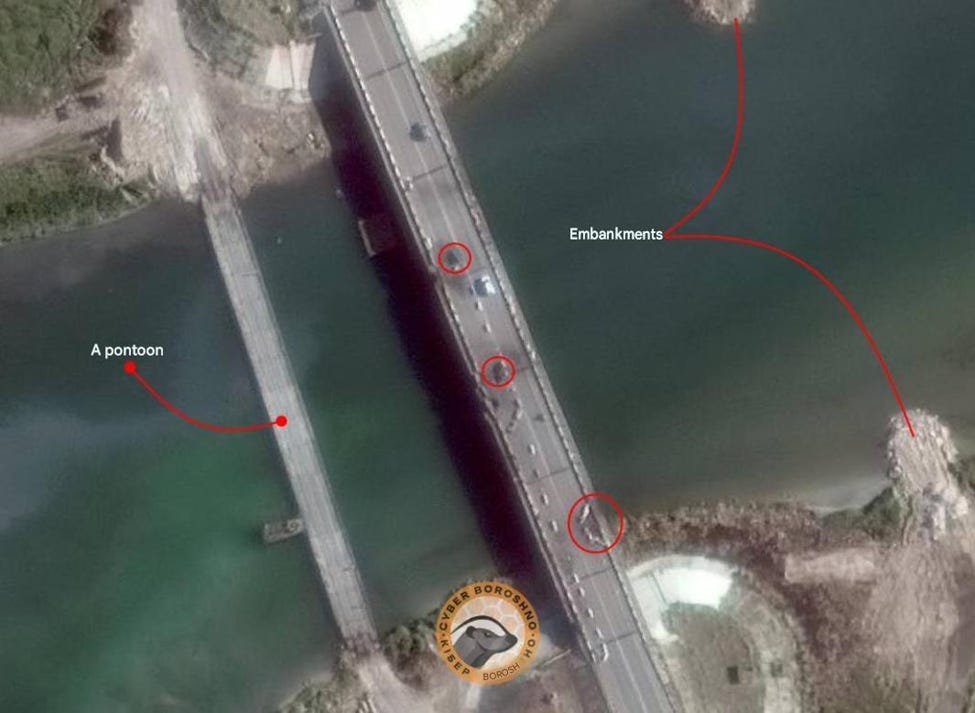
The Promoina Strait bridge at Henichesk was not destroyed, but Ukraine created three holes in the bridge. Passenger cars are still using the bridge as a single lane, but trucks are not.
Russia created ramps leading to a pontoon bridge. The pontoon bridge has been attacked and repaired at least once. This delays the trucks but does not block them. The pontoon bridges are a single lane and the trucks on each side have to alternate when crossing. While on the bridge the trucks need to be spaced out. As of 19 June, the pontoon bridge was reported abandoned by trucks, probably because of additional attacks. Subsequent images showed trucks using the bridge.
The crossing certainly has not been abandoned. Russia is constructing earthworks over the strait in order to build a bridge that is more durable than a pontoon bridge and cheaper and easier to repair than a concrete or pontoon bridge. There is no tidal action in the Sea of Azov because it is the shallowest sea in the world and there is a constant outflow of water into the Black Sea. Water movement between the Sivash lake and Sea of Azov depends on the direction of the wind. Because the Russians are building it, the earthen embankment may be completely solid without a passage for the wind-driven waters. Higher levels of explosives would be needed to destroy the embankment, and any surface damage would be repaired with earth and whatever is used for the surface, possibly crushed stone.
If Ukraine decides to attack the earthen road, it could delay repairs by attacking the dump trucks and other equipment needed for repairs. This equipment could be hidden inside Henichesk, so the best chance to damage or destroy it might be during the construction or repair of the road.
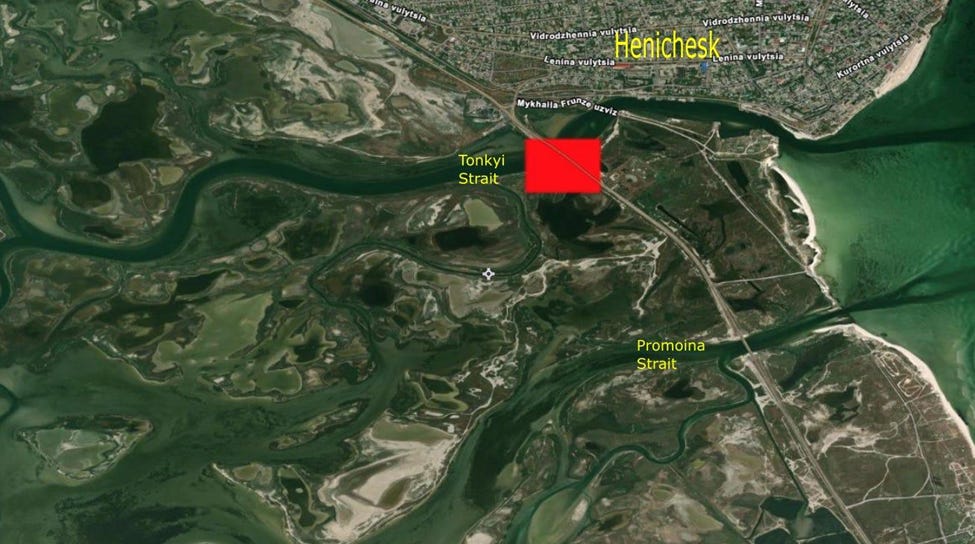
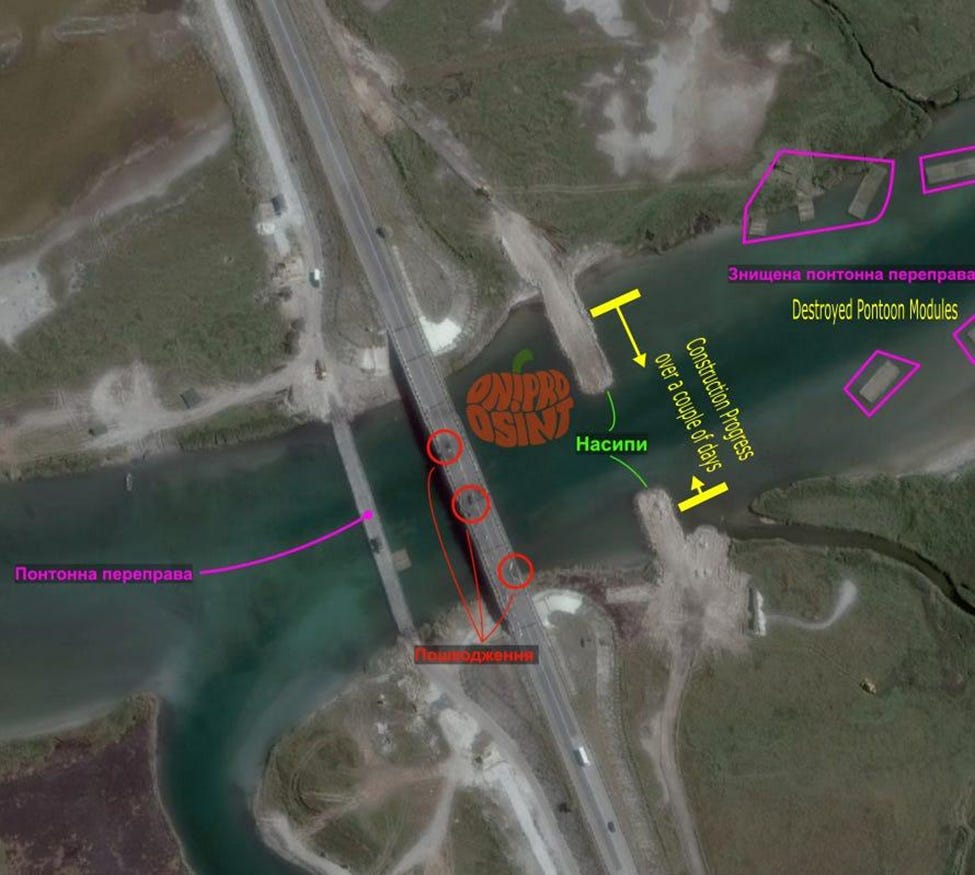
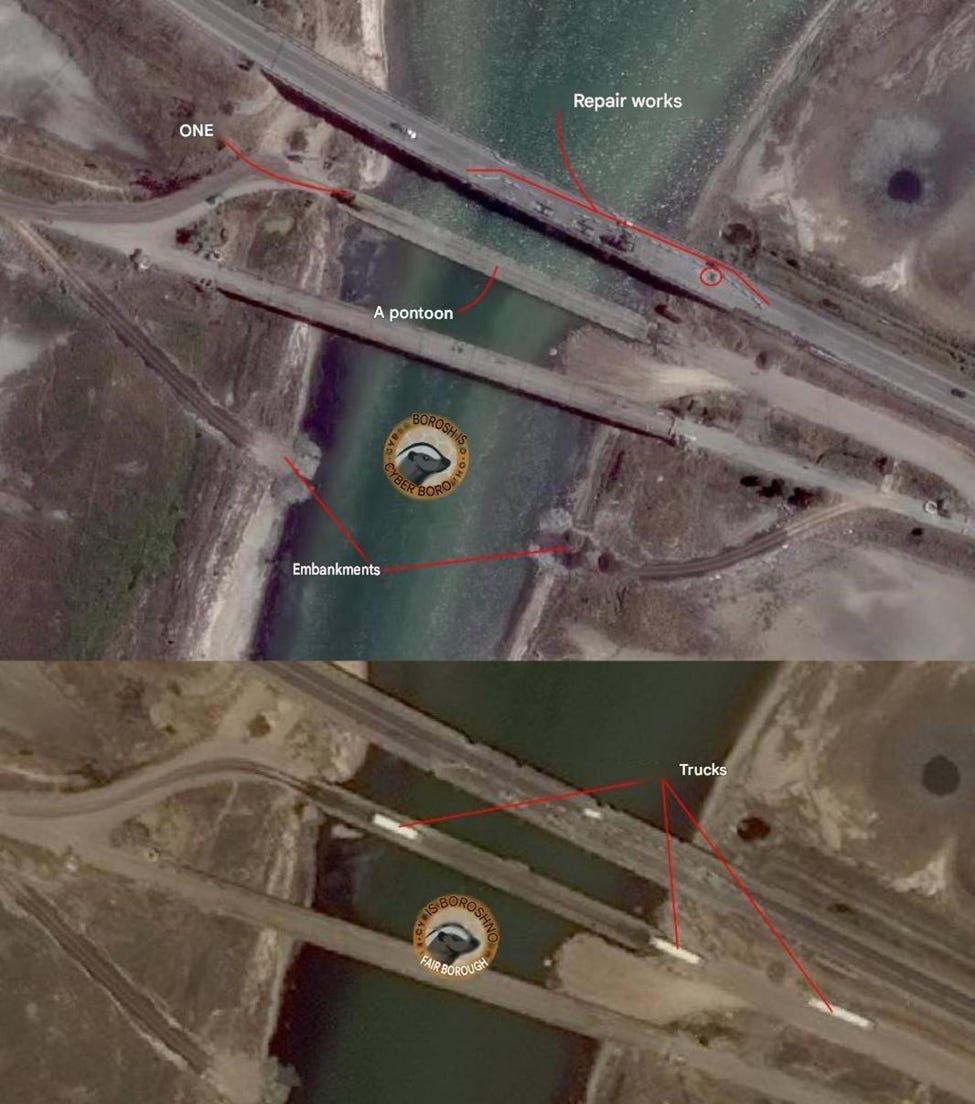
At Chongar, both the old and new highway bridges are damaged. The new highway is being repaired and is used by civilian cars only. Both trucks and civilian traffic are using a pontoon bridge in the middle. Embankments for an earthen bridge are being built.
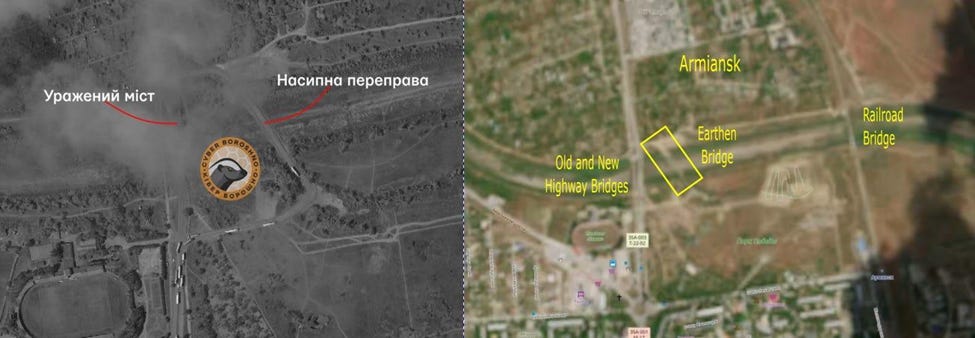
At Armiansk, the old and new highway bridges and the railroad bridge are damaged. A new earthen bridge was built across the dry canal.
Trucks that wait to cross have been attacked several times.
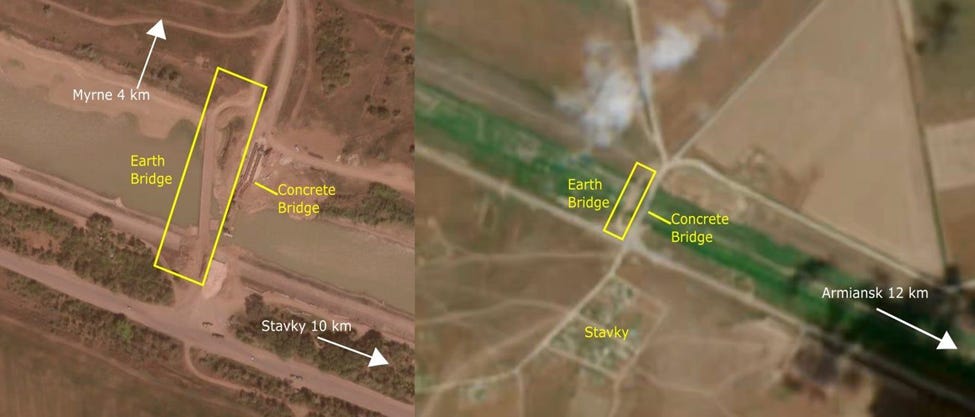
At Stavky, 12 km from Armiansk, an earthen bridge was built in the dry canal to replace the damaged concrete bridge. The bridge south of Myrne was attacked until it was destroyed. There is some water in the canal at this location but the earthen bridge is already built.
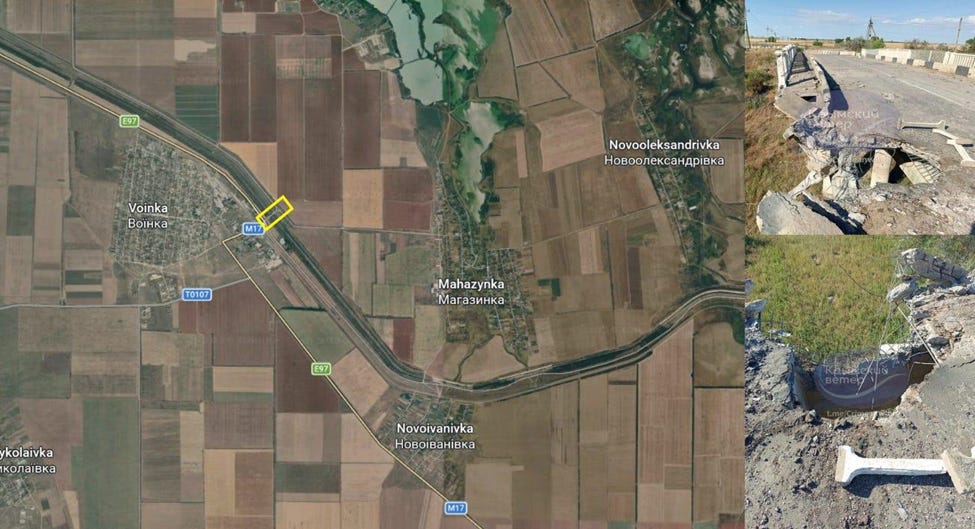
37 km southeast of Arimansk, another bridge on the North Crimean Canal was damaged at Voinka. If the crossing at Armiansk is impassable then trucks could have driven further south and crossed the canal here.
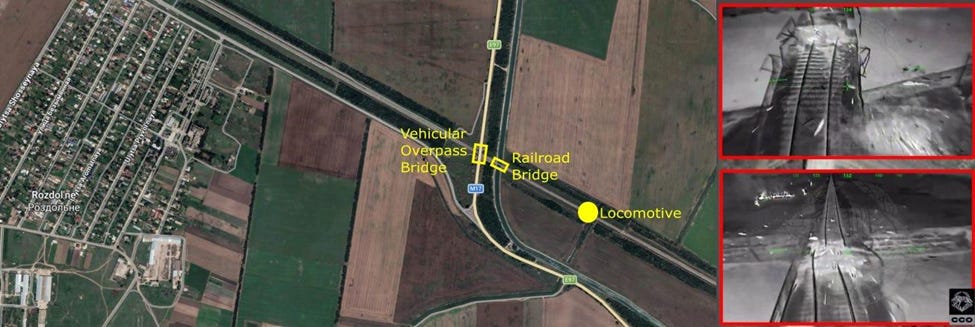
200 km from the front lines, a railroad bridge, a vehicular bridge that passes over the rail line, and a locomotive were attacked at Rozdolne. The extent of damage to the overpass is unknown.
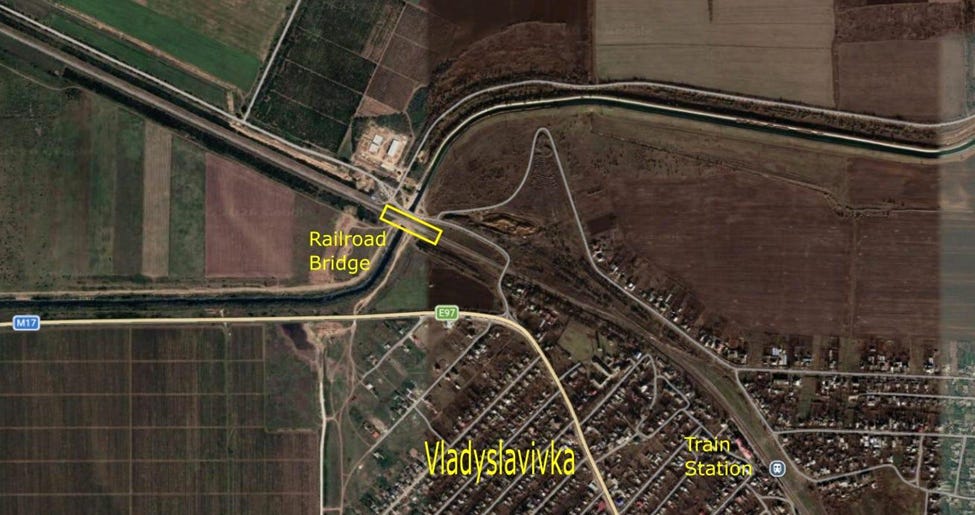
235 km from the front lines, the railroad bridge and train station at Vladyslavivka were attacked. With the severe damage of this bridge, trains coming from Kerch are unable to travel past Vladyslavivka. Since the railroad bridge at Chonar is also destroyed, most of Crimea cannot be reached by train. And since railroad bridges cannot be easily repaired or built, rail traffic into Crimea is blocked.
(…to be continued…)
This war has extremely light logistics. The trop and vehicle density îs incredibile low for a war beteeen industrial states. 1 km of front is held by 20-30 soldiers at most. Isolated pockets of resistance are resuplied by drops of 10 kgs per night.
Suffocating such logistics is incredibile hard.
Good post, earthen road crossings will have Russian AD/CUAS defense positions and coverage, tactical problem which have offensive counter for Ukraine.