
The Continuing Crisis of Command, Part 1
On Integrity and Trust, by Donald Hill

One of most important indicators on the status of an army is the degree of honesty that exists in how everyone communicates with each other.
For two years, from 2023-2024, the front lines around Siversk remained unchanged. The Russian commander kept reporting advances that never happened. Russian bloggers reported that the false reports led to higher Russian losses, and eventually, after so long without any progress and huge losses, the Russian commander was fired.
Three months later, in February 2025, the Russian forces began advancing. Slowly, and with losses, but a kilometer a month adds up. There were other factors involved, to be sure. A couple battalions from the area were sent to Kupiansk. The 54th Brigade’s excellent and dedicated K-2 drone battalion was expanded to a regiment, then to a brigade, and ordered to cover a wider sector with multiple sub-units. And there is simply less Ukrainian infantry on the ground than there was one or two years ago. But it’s likely that the Russian change of command was a factor, as well.
Bohdan Krotevych, the former Chief of Staff of the Azov Brigade, left the army to be able to speak freely about the problems in the Ukrainian army, and he spends a lot of time talking about Syrsky.
One of the points he makes is that while lying was a large part of the Russian military culture, it is increasingly happening in the Ukrainian military, as well.
Honest reporting is important because decisions are made based on the information given, and people live or die because of those decisions. If a unit withdraws for whatever reason and the units to its left or right aren’t aware of it, they won’t take any action to plug the hole or withdraw themselves. This means Russians can flow through that gap and attack the adjacent units from behind.
Mistakes are always going to happen in warfare. Information could be incomplete, or poor decisions with the correct information could lead to unnecessary losses. An honest assessment after each operation can determine what went wrong and what worked well, and it’s possible to learn from these mistakes and improve judgement with experience. If someone in a leadership position proves that they cannot learn with experience then they should be replaced.
It is important to listen to subordinates because they might have information that the commander didn’t have or they might have a better solution that the commander didn’t consider. A commander will still make the final decisions but it would be foolish to refuse to consider what subordinates have to say.
There are plenty of reports over the last couple of years that indicate Syrsky does not tolerate differing views from his subordinates and places so little trust in their judgement that he had told them how to deploy their forces down to the platoon level. This presumes that he knows more about the front line conditions, such as terrain, friendly force, enemy forces, etc., than the company, battalion and brigade commanders.
This, of course, is an impossibility.
Syrsky is also continuously and actively ceating conditions that encourage lying by giving orders that exceed a unit’s capabilities, such as forbidding withdrawals or counterattacking to regain lost ground, regardless of the situation. Sometimes if a unit fails an impossible order the commanders are removed. If a commander with superior information and judgement objects to an order, they are sometimes relieved. Sometimes they quit.
Pavlo Rozlach was commander of the 82nd Airborne Assault Brigade until he objected to the fruitless 2023 offensive operations around Robotyne and was removed from command. Emil Ishkulov was commander of the 80th Air Assault brigade until he objected to the ultimately fruitless 2024 Kursk invasion because his unit was still recovering when it was tasked with what he felt was an unrealistic objective without enough time, forces and people. He was replaced by Rozlach. And a battalion commander of the 47th Brigade, Oleksandr Shirshyn, resigned because he objected to orders to capture useless ground at the expense of high casualties. Yury Butusov said that those types of operations happened repeatedly without any consideration to learning lessons and improving performances.
When Mykhailo Drapatyi was appointed commander of the Ground Forces, he still had to answer to Syrsky, but he supposedly had the authority to give orders and make decisions just like Syrsky did when he answered to Zaluzhny. Drapatyi also demanded that leaders stop lying because it undermines the effectiveness of the army. When he gave orders to establish safety and security measures during training, and when commanders disobeyed those orders, Drapatyi attempted to fire them but was overruled by Syrsky. Certainly, if Syrsky was going to reach down and tell a platoon leader where to deploy his unit, he was going to micromanage Drapatyi, as well. Unable to perform as commander of the Ground Forces, Drapatyi resigned, and his replacement has had no noticeable impact on the army.
The lies extend to individual soldiers, as well. People that join with the promise of a job in an air defense unit, or a job as a mechanic or technician can easily be transferred to the infantry just three months later.
All these issues feed off each other.
● Commanders that want to stay in command lie when things go wrong, out of fear that they would be fired for reporting a setback. This endangers the personnel of that unit and the adjacent units.
● Commanders that object to ill-conceived operations are replaced, which allows the operations to continue with continuing consequences.
● Syrsky does not trust subordinates to do their job, so he micromanages even low levels of detail while lacking the knowledge needed to make sound judgements at every level of command. This results in poor outcomes and higher losses.
● Individual soldiers are lied to when they are told they will be assigned to one job but are then sent to the infantry, often without training. And the reason they are sent to the infantry is because of the high casualty rates that are partly caused by all the dishonesty and lack of trust in competent subordinates. The soldiers that leave their assignment due to lack of confidence in their chain of command reduces the army’s combat capabilities.
As it turns out, people that may be willing to fight for their country, even with the risk of death, still don’t want to die because of avoidable stupidity. And the average person doesn’t need to have a high level of military knowledge to know when the commanders of their unit aren’t being properly supported and/or are incompetent.
Ukraine reportedly received 30,000 recruits each month. Monthly AWOL/desertions have increased and 21,602 left their posts in October, although many return to find a position in a unit they trust. Many brigades don’t receive enough recruits from the army to replace their losses and struggle to attract recruits on their own. By contrast, the Azov brigade, which is constantly deployed in dangerous sectors, has a waiting list for volunteers wanting to join and reject people that don’t pass their selection process. A large number of those that abandon their post aren’t running from the dangers of the Russian army.
They’re running from leadership that they don’t trust or feel is incompetent.
The lack of trust between Syrsky and his subordinates extends beyond Syrsky’s micromanagement or being fired for questioning his orders, no matter how questionable they are. The Air Assault forces traditionally were used as a quick reaction force sent to any location that needed help. Sometimes the leaders of the Air Assault forces have questioned the judgement of their superiors. Eventually, Syrsky has established himself a separate sub-branch: the assault battalions that were gradually expanded to assault regiments became Syrsky’s fire brigades. Ultimately, the Assault Forces was formed with six assault regiments, commanded by Valentyn Manko. While many question his character and qualifications, he is not known for questioning Syrsky’s orders. (Here is an interview with Manko from October).
The soldiers of these units are excellent and have been used in many difficult situations, but many of these operations only push the Russians back temporarily. The recovered gains are often lost soon after, and the price paid is high. One assault regiment suffered more losses in one month than the Azov brigade suffered in two years. At a time when the majority of ZSU’s brigades are trying to hold the front line with 30% of their authorized strength, these brigades only receive 30 replacements a month. Some of the assault regiments are given 800 people in just one month. This has been happening for a long time and the former commander of the 93rd Brigade said it is long overdue to correct this.
The Ukrainian army also recently decided to break up the International Legion and use the thousand personnel as replacements for the assault regiments. The unit’s leaders and soldiers aren’t happy about being separated from each other. This breaks an assumed promise to the foreign soldiers, who can quit the contract after six months of service.
The chosen assault units also are better supported with equipment. Many good units never received top end equipment, such as Bradleys. The 3rd Assault Brigade received a small number and made every effort to use them wisely with operational planning and recovery operations. The commander of an assault regiment that lost two Bradleys to mines wasn’t as concerned, saying, “They’ll send us another one. It’s not a problem.”
● Nepotism not only allows substandard leaders to remain in command, it provides preferential supplies of personnel and equipment to the favored units. If brigades do not have their own supply of replacement personnel due to a trusted relationship with the public, then their ability to fight will be degraded, which will lead to higher casualties.
● Again, if the public doesn’t trust what the army leadership says and does then they are less willing to entrust their lives to them.
Defensive Operations
There are patterns to Ukrainian operations. One pattern is how cities and towns are defended long past it makes sense to do so.
Russian forces push hard on the flanks over weeks and months to partially encircle the city.
The partial encirclement leaves a narrow path for Ukraine to sustain the defenders in the city with supplies and replacements, and it is difficult to evacuate casualties because of drones and shelling. It also increases casualties among the Ukrainians providing logistical support.
With reduced sustainment capabilities, wounded defenders suffer higher mortality rates because they cannot be evacuated in a timely manner. Fewer replacements arrive to take the place of the dead and wounded. Gaps appear in the defenses because there are fewer defenders to fill the gaps. More defenders die because Russians move through the gaps to attack mortar, drone and logistical teams that would normally be protected. Logistical support to the front line defenders is reduced even more because of Russian troops on the ground behind them, along with the everpresent drones.
Reinforcements are sent to clear out the Russians that have broken through. The initial efforts may be successful but the holes can never be fully plugged and more waves of Russian trickle in.
Finally, after weeks or months of heavy losses, the decision is made to withdraw and Ukrainian forces suffer more losses in the process.
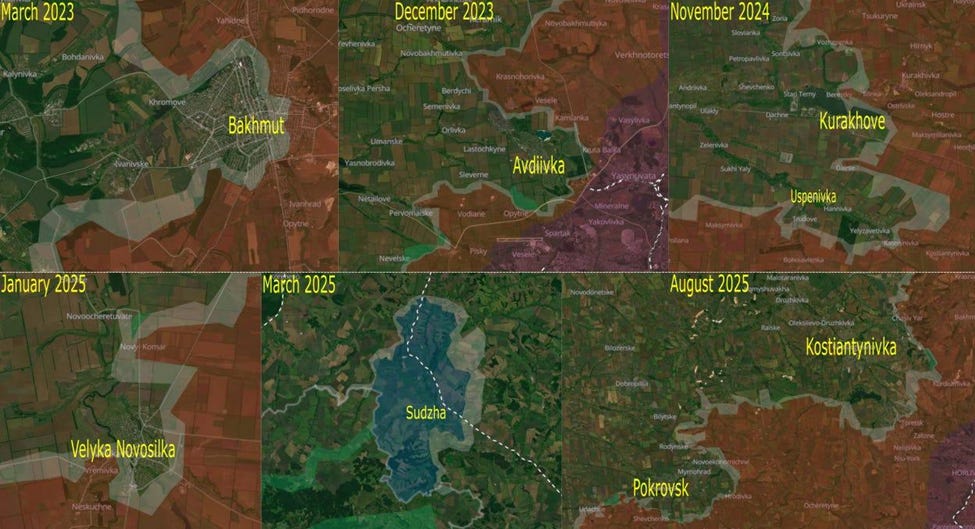
Not all cauldrons are centered on towns. The land east of Uspenivka were defended too long, and this happened in other locations, as well. Sudzha was the remnant of the Kursk invasion. 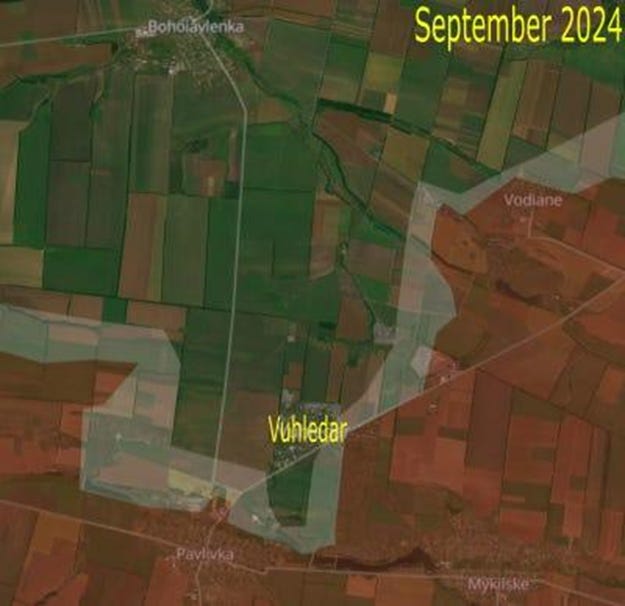
Vuhledar wasn’t as deeply encircled as other locations but the open ground to the north was a killing zone. Not everyone that left Vuhledar made it to safety. In attritional warfare the defender wants to hold ground that minimizes own casualties and maximizes the enemy’s casualties. If good ground turns into bad ground then the defenders need to withdraw to better ground - and do so on time. And if holding the city or town was so important, then it would make sense to defend the flanks of the city as hard as the city itself.


Plugging Gaps
Another pattern in operations of the ZSU is that whenever Russia makes a deep, narrow penetration through a gap, Ukrainian forces often respond slowly and ineffectively. Every brigade should have a reserve force that can prevent or react to breakthroughs in their sector. Some have this capacity. However, the majority of brigades only have 30% of their assigned strength and can’t properly man the sectors they’ve been assigned.
Each corps should have a reserve force to help any of the brigades in their sector. Some do, others show no evidence of having one.

Theoretically, the ZSU has a reserve force. This is rarely used: most of time, Syrsky detaches battalions, or even companies, from brigades and sends them from other locations to fill the gap. This weakens the other units and increases the communication problems between all the different units on the front line. Timely and truthful communications is already a problem between many Ukrainian units. Increasing communication issues will only make it more likely that more gaps will appear, creating greater losses and even bigger gaps in a continuing downward spiral.

***
(…to be concluded in the Part 2…)
So the worst we hear about command seems to have been true all along. This rot at the top is such a disgrace when brave soldiers' lives are at stake. Zelensky must know all this, which makes him complicit. How depressing.
100% agreement and that is why I now for the first time lose hope that Ukraine will survive. The system Syrsky created is like a malign fast growing tumor and we all know what happens if the tumor spreads too much.
It is so bitter, that everything was avoidable.
Nevertheless whatever will happen, doesn't depend on my conclusions.