

(…continued from Part 1…)
Ukrainian Agriculture
Even so, Ukraine remains far from having a sustainable business model. With its fertile black-earth soils, Ukraine remains a heavyweight in agricultural markets. Together, these products accounted for roughly half of the 81 billion US dollars in export revenue.
With 2.4 million tonnes of sunflower seeds alone in the first half of 2025, Ukraine remains to this day the world’s largest exporter of sunflower seeds and sunflower oil. The sector exported over nine billion dollars’ worth, primarily to Europe, the Middle East, and Asia.
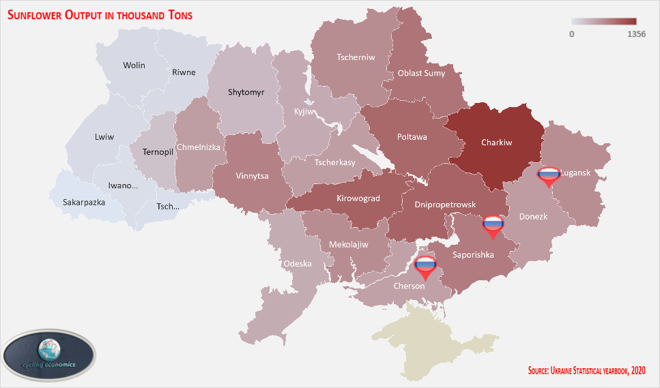
However, most of this production is located in central Ukraine and, above all, in the eastern part of the country, where production sites remain acutely exposed to Russian strikes. Along the front line and in formerly Russian-occupied territories, mines and drones lie in wait, threatening to destroy heavy equipment such as tractors or combine harvesters. These will continue to pose problems for tilling, sowing, and harvesting for a long time to come. This is especially significant since sunflower production is particularly concentrated in the east.
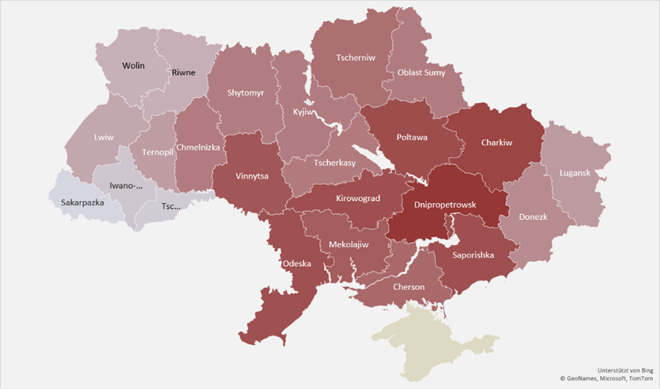
Production is somewhat more evenly distributed for grain, which accounted for 9.42 billion US dollars, or 23 percent, of export revenue. Still, the main burden falls on the east — Dnipropetrovsk, Zaporizhzhia, Kharkiv — when looking more closely at the acreage under cultivation.
Resource Extraction and Mining
Although more of an industrial powerhouse in Soviet times, Ukraine’s soil also holds numerous mineral resources, which were once used as a bargaining chip with Donald Trump.
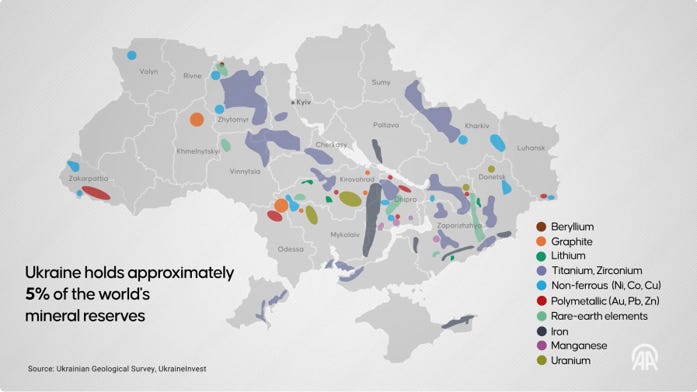
The country is home to 25 of the 34 strategic raw materials classified as critical by the EU, including graphite (important for batteries, steel, fuel cells), lithium (batteries, aerospace), titanium (defense industry, aviation, medical implants), beryllium (aviation, defense, nuclear energy, electronics), and uranium. All of these are indispensable for the green transition and for the strategic independence that Europe is pursuing in this area.
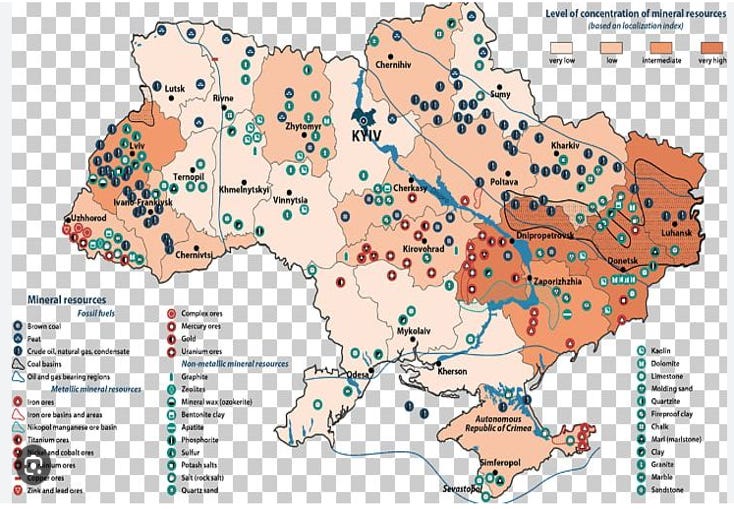
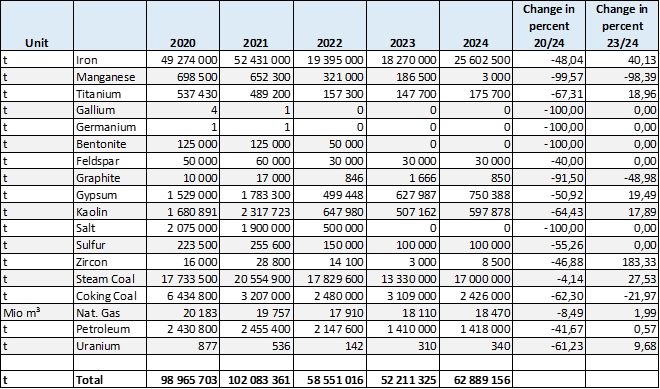
But once again, a disproportionate share of these resources lies in contested or at least heavily endangered territories. Correspondingly steep declines can be observed in the extraction of numerous resources.
In some cases, such as manganese, extraction collapsed entirely; graphite fell by 92 percent, titanium by 67 percent, and iron ore, sulfur, and zirconium by roughly half.
Ukraine’s Export Balance
Looking at these maps, it is hardly surprising that Ukraine’s export balance in goods and services is also declining — in truth, it has already been on a downward trajectory for a long time, both in absolute terms and relative to economic output.
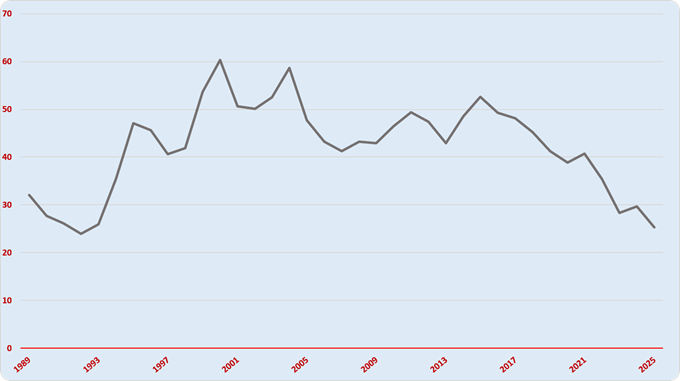
With the first year of the war in 2014, trade with Russia and its Eurasian Economic Union, previously the main buyer of Ukrainian goods, did not collapse immediately, but it did enter a constant downward spiral. The Europeans then added insult to injury by shielding themselves from an increasingly EU-oriented Ukraine through technical barriers on food products, in order to protect their own agricultural industry from too much competition. European markets not only failed to compensate for the losses from exports to Russia — the trade balance actually shifted further into negative territory, to Ukraine’s disadvantage.
The continuous decline in exports since the outbreak of war is most pronounced in high-value-added products: exports of metal and steel goods, machinery and equipment, and chemical products fell by between 6 and 17 percent from 2024 to 2025 alone. This is partly because capacity is needed for the domestic defense industry, and partly because many plants are idle due to the threat of Russian air strikes — such as Kryvorizhstal, ArcelorMittal’s largest steelworks.
Exports of iron ore products fell similarly, by a further 17 percent. Among agricultural exports, the drop in grain and oilseeds stands out especially, down 23 and 30 percent respectively. Only processed foods, meat, and dairy products managed to offset this to some extent. Of all trading partners, it is the EU that is taking in ever fewer goods — down 6.6 percent, or 1.5 billion US dollars (which, given high price inflation, means an even steeper decline in actual volumes).
It hardly helps that the EU has now graciously allowed more sugar, honey, and corn into the bloc — at least as long as no individual EU country comes “under (unspecified) pressure” and Ukraine adheres to European pesticide limits. Of all destinations, exports to CIS countries, and thus to Putin’s prestige project, the Eurasian Economic Union, rose by 262 million US dollars, with smaller increases to North and South America and Africa as well.
On the other side of the ledger, imports grew — from Asia by 7.4 billion US dollars and from the EU by 3.8 billion US dollars. As a result, Ukraine’s current account deficit with the rest of the world nearly doubled within a single year, rising by 16.9 billion dollars to over 33 billion US dollars (or from 8.9 percent of GDP to 15.6 percent).
Remittances From Abroad
It hardly helps either that remittances from refugees abroad are no longer counted as imports.
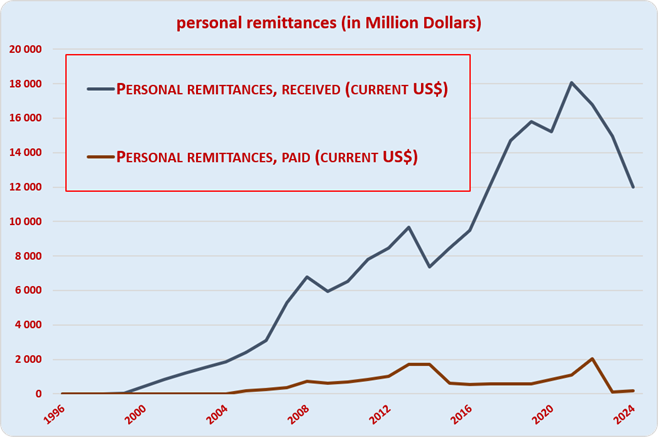
Ukraine’s own diaspora has long been one of the country’s main financiers. Remittances have for a long time represented an important economic factor for the country. Twenty million Ukrainian emigrants and their descendants live scattered around the world, from where they send billions of US dollars back to their families. Because this money flows between family members and people in a relationship of trust, it is also far more effective than official development aid — less of it gets embezzled, and it is spent on what it was intended for: education, living costs, and investment.
These remittances also benefit the state, since they flush foreign currency into the economic cycle and generate tax revenue, thereby easing the burden on the state budget. In 2021, they accounted for as much as 12 percent of Ukrainian economic output — three times as much as foreign direct investment (that is, factories built by foreign companies).
For decades, Russia, with its higher wages, shared history, and numerous family ties, was the main destination for migration. The migration corridor between Ukraine and Russia was among the largest in the world — nearly 4 million people born in Ukraine were living in Russia in 2024, and only slightly fewer people born in Russia were living in Ukraine, according to the United Nations.
Since 2014, Poland has overtaken Russia as the leading source country of such remittances, accounting for 39 percent, followed by the US and, to a smaller extent, the UK, Germany, and Italy. However, the National Bank of Ukraine itself describes remittances from Russia as massively undercounted — many seasonal workers used to bring cash with them before the war, and Russia’s central bank has since stopped cooperating on transaction reporting.
Even after the full-scale invasion, an estimated two to three million Ukrainians were reportedly still in Russia, and 1.3 million refugees ended up there as well (though a meaningful distinction from forced deportations out of occupied territories is not possible). This is by no means meant as a political statement — rather, many are connected through family ties that can offer them a foothold and housing.
But here, too, Ukraine is suffering losses. Many Ukrainians abroad have now taken in their relatives directly, rather than sending money back to Ukraine. Many men who are not allowed to leave the country send money to their wives and children abroad to support them. In some cases, this has even reversed the direction of remittances entirely. Divorce rates are high — an acquaintance from Kharkiv told me that 50 percent of the men who sent their families to Europe are now divorced. Their children, after four years of war, are beginning vocational training abroad; others are starting new careers elsewhere. Most will not return.
The End of Ukraine’s Business Case
The longer the war lasts, the more the country is losing its business model altogether — assuming it ever really had one since its founding in 1990. With its strong (defense-related) industry, the country came out of the Soviet era considerably worse off than most other former Soviet republics in Europe. It simply lost its main customers.
Ever since, it has been scraping by from one emergency loan from the International Monetary Fund to the next. In return, the IMF demands a harsh austerity course, which cuts public services and social benefits for the country’s own citizens. In the long run, this only further erodes their trust in the state.
Almost all structures and life plans in Ukraine are therefore built around short-termism, in order to be able to react to constant uncertainties — whether inflation, sudden shifts in commodity prices, instability, or conflict. Rarely has the country been in a position to take its own future into its own hands. This uncertainty, in turn, means that hardly anyone is willing to invest over a long time horizon — rather than building something in Ukraine, businesses and ordinary citizens increasingly see their future in a safer country abroad.
Looking at the maps of agricultural land, mineral deposits, and the existing industrial base, these sectors appear more than ever to be in decline. Export revenues, remittances, industrial and food production, and raw materials all lie within range of Russian weapons, while at the same time the country is bleeding out workers who could otherwise be paying taxes and generating output. The economic situation is therefore bleak even beyond the obvious, direct damage caused by the war.
From where things currently stand, Ukraine faces an evident problem in figuring out how it could get back on its feet economically, regardless of how the war ends. I will go into more detail in the next part about what possibilities I see for Ukraine from this difficult starting point.
(…to be continued tomorrow with ‘Part 3: An Economic Future for Ukraine’…)
Thanks.
Thanks