

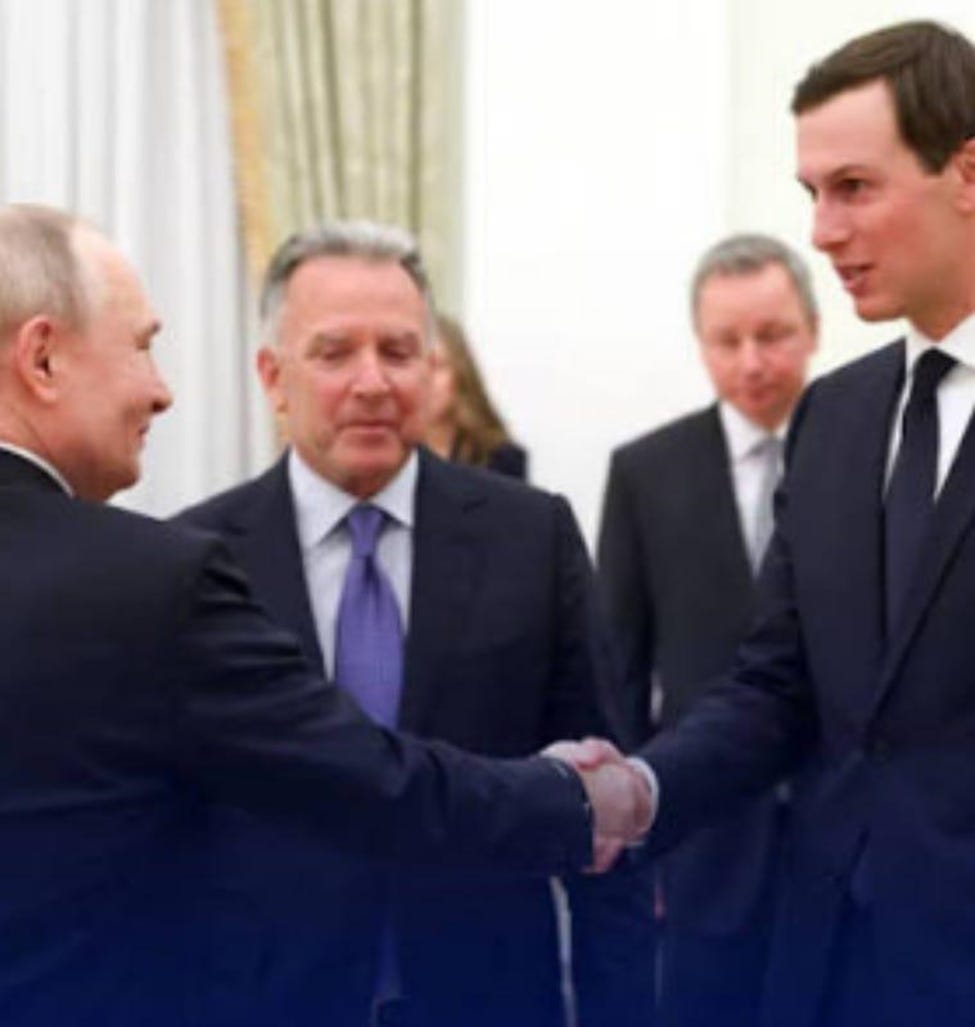
In early September this year, Trump’s son-in-law, Jared Kushner, sat down with Putin in Moscow. Putin said that Russia would capture the Donbas in months and Ukraine’s electrical grid will be destroyed by winter. Kushner said they heard that a year ago and wondered if Putin would be saying that a year from now. He suggested that maybe they shouldn’t lose a year. The Trump administration is considering signing business deals with Russia before the fighting stops as a way to show Russia they are serious about a reset of relationship with Russia.
Last year, Trump said that there would not be any business deals with Russia until the war ended, but Trump’s promises have little value. It also conflicts with the beliefs of Republicans and Democrats in Congress that believe only economic and military pressure can force Putin to compromise. Then there is the reality that resets with Putin or Russia have not worked historically, and that Putin cannot compromise and that the only option is to eliminate his ability to make war.
When Kushner spoke on a video link to international supporters in Kyiv and said that Putin is “very committed” to moving forward with a peace plan, members of the audiance laughed.
Ever since Trump returned to office in 2025, Russia has been tempting him with business deals. Gentry Beach, a friend of Donald Trump Jr., signed an agreement with Russia to develop natural gas in Alaska, saying, “Trump is a transactional president. I don’t think people would have felt as comfortable working with Russian companies during the Biden administration as they do during the Trump administration.”
Kushner and Steve Witkoff, a real estate investor, have been involved in negotiations regarding Ukraine, Gaza, Iran and other conflicts. Knowing a region’s history or someone’s negotiating stance isn’t important to him. He believes in hearing what both sides want and splitting the difference. He said that peace-deals are like real-estate deals: They both involve hard bargaining and, at times, bluffing.
“I’ve been getting criticized for the last couple of years, by all the people who have tried and failed, for not doing this the same way that they have. If somebody was successful, I wouldn’t be dealing with this,” Kushner said in 2020 after Trump unveiled his first Middle East peace plan.
Prior to the war with Iran, the US demanded that Iran give up their large stockpile of low-grade uranium that was buried under the rubble from the 2025 bombing. Technical issues, such as the speed of centrifuges or methods of verifying disarmament, were complicated, but Kushner and Witkoff did not bring the technical advisors assigned to them by the Department of Energy into the room.
When the Iranians offered concessions, Kushner and Witkoff didn’t recognize them as such. They believed that Iran was just stalling when they offered to stop enriching uranium and offered to dilute the stockpile that they already had.
A research reactor in Tehran was producing medical isotopes and Witkoff accused them of trying to enrich and stockpile uranium, even with repeated IAEA inspections said otherwise. A nonproliferation expert said, “You can tell by what Kushner and Witkoff are saying that they don’t understand a lot of the technical issues.”
Kushner doesn’t respect experts. When a former Republican official offered to find staffers with subject matter expertise, Kushner declined, saying, “You don’t understand. We’re bringing in billionaires—billionaires.”
Oman’s foreign minister that hosted the negotiations appeared on the news and called for patience, saying, “The peace deal is within our reach.” Kushner and Witkoff told Trump that Iran refused to capitulate. Hours later, the US and Israel launched attacks that killed Iran’s senior leadership. Kushner justified the war, saying, “They basically could have been, you know, days or weeks away from a weapon, if they would have put the effort into it.” The IAEA saw no signs of a revived weapons program.
The Secretary of State, Marco Rubio, had a different explanation. US intelligence officials pinpointed the location of senior Iranian leaders and provided that information to Israel. Israel chose to strike. He said at that point, the US couldn’t avoid a war with Iran. “There was going to be an Israeli action. We knew that that would precipitate an attack against American forces.”
To be sure, Kushner was hardly an impartial negotiator. His father, convicted of tax evasion, witness tampering and wire fraud, and is not ambassador to France, had not only donated $2.5 million to Havard so his son could attend, he also supported Israeli policies and contributed to organizations that supported settlements on the West Bank. Netanyahu was an old family friend and once spent the night in Jared’s bedroom.
But it was also just business for Kushner. After Trump reluctantly left office in 2020, Kushner started the Affinity Partners investment fund. He never ran an investment fund before. Since it is a private investment, it’s excluded from the Investment Company Act of 1940 and is therefore not subject to the same anti-money laundering and beneficial ownership reporting requirements of other financial institutions.
A retired army major general is on the payroll, and the law prohibits retired military personnel from accepting payments from foreign governments. But with this loophole, MG Correa can be paid by the private investment fund in which 99% of the funds originate from foreign nations. Saudi Arabia invested $2 billion despite noting that Kushner didn’t have an investment track record and acknowledging they would be assuming the bulk of the investment and risk. Qatar and the UAE also made $200 million investments, and Affinity had $2.973 billion in funds. Terry Gou, a Taiwanese billionaire that employs a million people in mainland China and another unnamed foreigner provided the rest of the money. As a Kushner acquaintance said,“It’s not complicated. All the Middle Eastern countries invest in Jared’s fund, and they suck his dick, so they can get political favors from the Trump Administration.”
An economic analyst that runs an investment firm said he’s never seen a US private equity firm so dependent on foreign cash. In 2024, Kushner announced a $500 million real estate project in Serbia at the same site where Trump previously tried to build a luxury hotel, but they had yet to earn any money for their investors while collecting $157 million in fees. And that Serbian project was cancelled when Serbian prosecutors charged the minister of culture with falsifying documents to secure permits.
Right before the election, when it was clear that Trump would win, Qatar and UAE invested another $1.5 billion in Kushner’s fund. When Kushner rejoined Trump’s team, he refused to take a salary and White House lawyers proved it was impossible for his government and business interests to conflict.
Kushner started Brain Co. in September 2025, which was supposed to sell AI services to businesses and governments. Mexico’s former foreign minister, a contributor to Republican campaigns and a contributor to Trump’s Inauguration are his partners in the venture.
Corruption wasn’t Kushner’s only shortcomings. Said Witkoff, “Jared and I both know what we don’t know. We’re going to be O.K. not knowing something and then getting curious and getting smart on the issue.”
A former senior Trump foreign-policy official said Kushner and Witkoff had little understanding about the war in Ukraine. They both believed Putin was “a good guy” and that “the Russian army was invincible.” He added, “They think this is a real-estate deal. They don’t seem to understand this is a war.”
After meeting with Russian and Ukrainian delegates, Kushner and Witkoff said the new plan would require Ukraine to cede territory, promise to never join NATO, and drastically shrink its army. Rubio dismissed it as “Russia’s wish list.” There is a widespread belief that Russia offered the two business deals in exchange for peace on their terms. European intelligence says that Trump and his people have discussed several potential contracts in Russia since the Anchorage meeting in August 2025. Twice the head of Russia’s sovereign wealth fund, which helps pay for the war, entered the US to discuss investment opportunities.
A European classified intelligence report listed ten potential projects, such as reopening Nord Stream 2 under American control, resuming ExxonMobil’s operations in Sakhalin island, and drilling for oil in the Sea of Okhotsk. There was talk of unfreezing Russian assets held by the US. The people listed as possibly participating included Trump, Kushner, Witkoff, Gentry Beach and Richard Grenell, a former Presidential envoy. The official that provided the intelligence report said, “The privatization of American foreign policy is quite far along. The deals would be executed the moment Trump delivers a peace deal.”
The Russians offered business deals if Kushner and Trump could deliver Ukrainian territory. While negotiating with Iran in 2025, new investments from the Middle East increased the Affinity fund by 30% to more than $6 billion, which provided millions more in management fees. But the US allies wanted stability and the Gulf is anything but stable. Russia wanted territory that isn’t being delivered. And the Democrats are likely to win the House, giving them the ability to conduct investigations, even if there’s little they could do towards holding people accountable. In the meantime, Kushner, Trump and their allies continue to mix business with diplomacy and make billions of dollars.
Parasites
Hello, Donald and maybe Tom too.
First, thanks for this.
I find it a bit hard to think the USA aren't… screwed? I mean, what you explained here is supposedly accessible to the American public, and yet we don't hear about mass protest calling for the resignation of these men. So even when their president dies or whatever, if the population is okay with that, they could just vote for the next one of the same mould. And if in addition to having no ethics, the next is actually smart… Well I'll stop there, don't want to be an alarmist